This post contains affiliate links. As an Amazon Associate, Nailz in Bloom earns from qualifying purchases, at no extra cost to you.
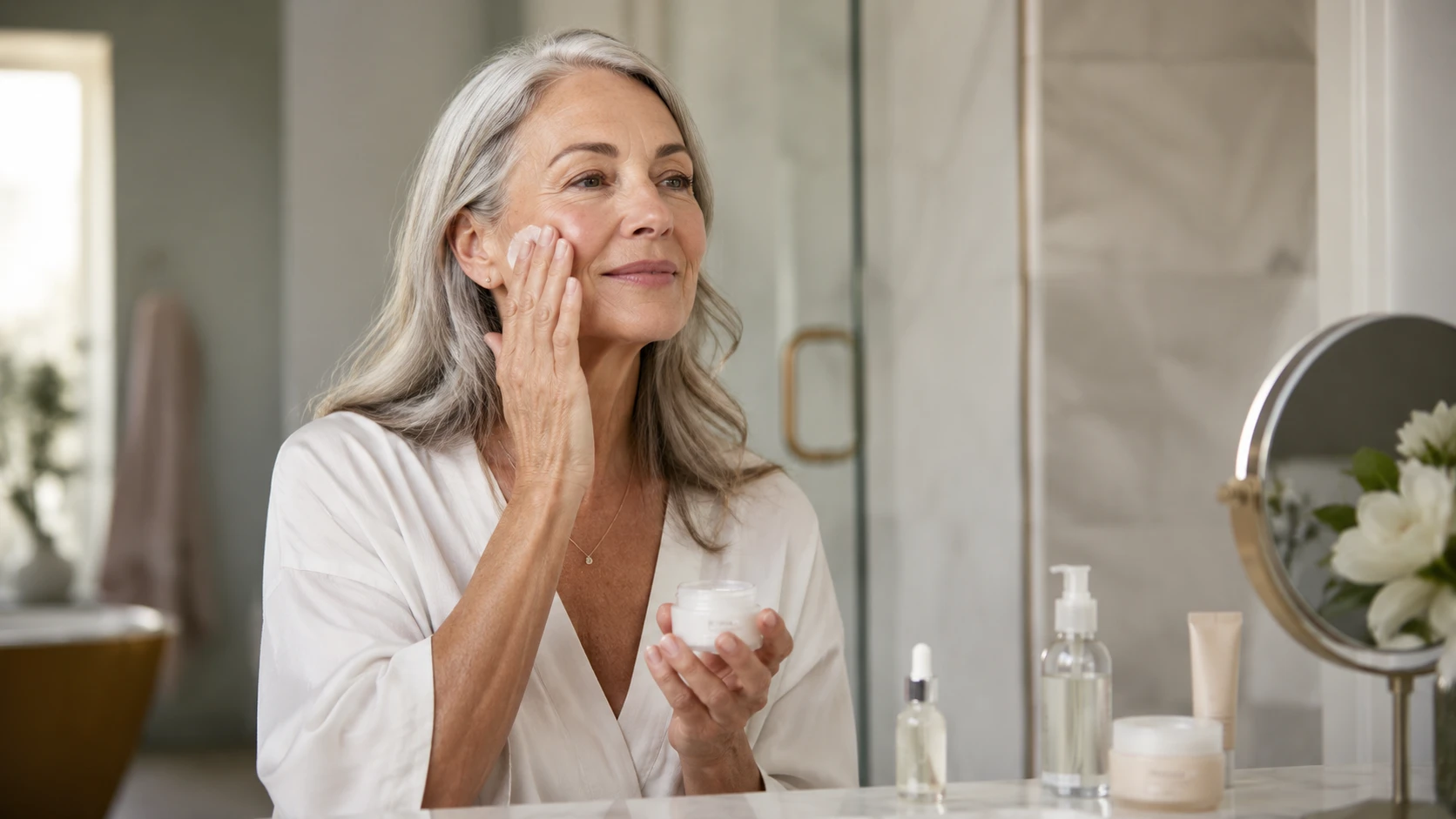
A skincare routine for menopausal skin should prioritize hydration, barrier repair and firmness, applied in a simple order from lightest to richest. The essentials are a gentle cleanser, a hydrating serum, a ceramide moisturizer, daily SPF and one evening treatment. Consistency matters far more than the number of products.
Why Menopausal Skin Needs a Different Routine
A menopausal skincare routine is a shift in priorities, not just more products. The routine that served skin in its 30s often stops working, because the underlying skin has changed. As estrogen falls, skin becomes drier, thinner, more reactive and slower to renew, so the goal moves from controlling oil to restoring moisture and support.
According to the American Academy of Dermatology, skin in menopause loses collagen quickly, holds less water, and often becomes more sensitive, which means harsher, stripping products can do more harm than good. The routine has to become gentler and more nourishing at the same time.
According to a 2025 narrative review published in PubMed Central, the estrogen decline of menopause is linked to reduced collagen, a thinner dermis and a weakened moisture barrier. A well-built routine targets each of those: hydration and barrier lipids for the moisture problem, and collagen-supporting actives for firmness and texture.
Because menopausal skin changes across several fronts at once, it helps to think in terms of concerns rather than a single fix. Sum of All frames these as the visible shifts of menopause, matching each change (dryness, dullness, loss of firmness) to the ingredients that address it, so the routine has a clear job at every step.
The Core Routine: What Every Step Does
You do not need a shelf of products. A menopausal routine of four to five core products is enough for most people. It is not a case where more steps automatically mean better skin. Each step has a specific role, and choosing one good product per role beats owning ten you use inconsistently.
| Step | Product | Job in Menopausal Skin |
|---|---|---|
| 1 | Gentle cleanser | Remove impurities without stripping oils |
| 2 | Hydrating serum | Draw water in (hyaluronic acid, glycerin) |
| 3 | Treatment (PM) | Support firmness and renewal (retinoid, peptide) |
| 4 | Moisturizer | Rebuild the barrier (ceramides, fatty acids) |
| 5 | Sunscreen (AM) | Protect remaining collagen from UV |
According to The Menopause Society, gentle cleansing, consistent moisturizing and daily sun protection form the foundation of caring for skin through menopause, with targeted treatments layered on top. Notice that hydration and protection are non-negotiable, while the “active” treatment is the one you introduce most carefully.
The beauty of a small core routine is that it is sustainable. Because results build over weeks and months, a routine you will actually follow every day is worth more than an elaborate one you abandon after two weeks.
Your Morning (AM) Routine
The morning routine is about hydration and protection. The primary job of a menopausal morning routine is to defend the skin, not to treat it. Daytime is when UV, pollution and dry air do their damage, so the focus is on shielding what you have.
A simple, effective morning order:
- Cleanse with a mild, non-foaming cleanser, or simply rinse with lukewarm water if skin feels comfortable.
- Antioxidant serum, such as vitamin C, to help defend against environmental stress and support brightness.
- Hydrating serum with hyaluronic acid or glycerin on slightly damp skin.
- Moisturizer with ceramides to seal in hydration and reinforce the barrier.
- Broad-spectrum SPF 30 or higher, every day, as the final step.
According to the American Academy of Dermatology, daily broad-spectrum sunscreen is one of the most important steps for menopausal skin, because it protects the collagen you still have from further breakdown. Sunscreen is not an optional extra here; it is the step that preserves the results of everything else.
Your Evening (PM) Routine
The evening routine is about repair and renewal, when skin does most of its natural recovery. This is where treatments that support firmness and texture belong, because they work best without daytime UV exposure.
A gentle evening order:
- Cleanse to remove sunscreen, makeup and the day’s buildup.
- Hydrating serum to prep the skin with moisture.
- Treatment, such as a retinoid for renewal or a peptide serum for firmness, a few nights a week to start.
- Richer moisturizer or night cream with ceramides, squalane or niacinamide to repair the barrier overnight.
| Concern | Evening Ingredient | How to Introduce It |
|---|---|---|
| Fine lines, slow turnover | Retinoid | 2 to 3 nights a week, build up |
| Loss of firmness | Peptides | Nightly, gentle and well tolerated |
| Dryness, tightness | Ceramides, squalane | Nightly, as the final layer |
| Dullness, uneven tone | Niacinamide | Nightly, pairs well with most steps |
Retinoids should be introduced slowly on menopausal skin, not all at once. Because menopausal skin is often drier and more reactive, starting a strong retinoid every night frequently causes flaking and irritation. Applying a gentle retinoid two or three nights a week, buffered with moisturizer, lets skin adapt. For a concern-led way to choose evening treatments, Sum of All groups products by the shift they target, making it easier to pick the right treatment for firmness or texture without overloading your skin.
Layering Order and Common Mistakes
The rule for layering is simple: apply products from thinnest to thickest. Serums go before creams, not after. Applying a rich moisturizer first can block a lightweight serum from absorbing. Water-based hydrating serums sink in first, treatments next, and richer moisturizers and oils last to seal everything in.
According to The Menopause Society, gentleness and consistency matter more than aggressive treatment for menopausal skin, and several common habits quietly work against that goal.
The most frequent mistakes:
- Over-cleansing or using foaming, stripping cleansers, which worsen dryness and sensitivity.
- Skipping moisturizer after actives, leaving reactive skin unprotected.
- Layering multiple strong actives at once (for example a retinoid plus a strong acid the same night), which irritates the barrier.
- Forgetting daily SPF, which undoes the firming and brightening work of the rest of the routine.
- Switching products too often, before any of them have had eight to twelve weeks to work.
Apply products to slightly damp skin to help humectants pull in water, give each new addition time before adding another, and let SPF anchor every morning. A calm, consistent routine is what menopausal skin responds to best.
Frequently Asked Questions
Apply from thinnest to thickest. In the morning: cleanse, antioxidant serum, hydrating serum, moisturizer, then broad-spectrum SPF. At night: cleanse, hydrating serum, a treatment such as a retinoid or peptide, then a richer moisturizer. Layering lighter textures before heavier ones helps each product absorb.
A core routine of four to five products covers most needs: a gentle cleanser, a hydrating serum, a moisturizer with ceramides, daily SPF, and one evening treatment such as a retinoid or peptide. Consistency with a simple routine outperforms a large collection used irregularly.
Retinoids can support firmness, texture and cell turnover, which all slow during menopause. Because menopausal skin is often drier and more sensitive, start low and slow, using a gentle retinoid two or three nights a week, buffered with moisturizer, and build up gradually as your skin tolerates it.
Hydration and comfort can improve within days, but firmness, texture and tone build slowly because cell turnover slows with age. Give a new routine at least eight to twelve weeks of consistent use before judging whether it is working.
The two routines have different jobs. Mornings focus on protection with antioxidants and SPF, while evenings focus on repair and renewal with treatments and richer moisturizers. You can share some products, such as your cleanser and hydrating serum, across both.